




What are the measurement limitations of a Split Core Current Transducer for high - frequency current?
 Oct 31, 2025|
 As a supplier of Split Core Current Transducers, I've witnessed firsthand the widespread use of these devices in various electrical measurement applications. Split core current transducers are incredibly useful tools, offering the advantage of easy installation without the need to disconnect the primary conductor. However, when it comes to measuring high - frequency currents, they do have certain limitations.
1. Frequency Response Characteristics
One of the primary limitations of split core current transducers in high - frequency current measurement lies in their frequency response. These transducers are typically designed to operate within a specific frequency range, usually from a few hertz to several kilohertz. The core material used in split core current transducers plays a crucial role in determining their frequency response.
Most split core current transducers use ferromagnetic cores, such as silicon steel or ferrite. These materials have excellent magnetic properties at low frequencies, which allows for accurate current measurement. However, as the frequency increases, the magnetic properties of these materials start to degrade. Eddy currents are induced in the core, which cause power losses and distort the magnetic field. This results in a decrease in the transducer's accuracy and a reduction in its output signal.
For example, at high frequencies, the inductive reactance of the secondary winding of the transducer increases, while the resistance remains relatively constant. This change in the impedance characteristics can lead to a phase shift between the primary current and the secondary output current. As a result, the measured current may not accurately represent the true value of the high - frequency current.
2. Skin Effect
The skin effect is another significant factor that limits the measurement of high - frequency currents using split core current transducers. The skin effect refers to the tendency of an alternating current to distribute itself within a conductor in such a way that the current density is higher near the surface of the conductor than at its center.
As the frequency of the current increases, the skin depth (the depth at which the current density is reduced to a certain fraction of its value at the surface) decreases. In high - frequency applications, the current may be concentrated in a very thin layer near the surface of the conductor. Split core current transducers are designed to measure the total current flowing through the conductor. However, due to the skin effect, the transducer may not be able to accurately sense the high - frequency current, especially if the conductor has a large cross - sectional area.
For instance, if the conductor is a thick copper busbar carrying a high - frequency current, the current may be concentrated near the outer surface of the busbar. The split core current transducer, which encircles the entire conductor, may only measure a fraction of the total high - frequency current, leading to inaccurate measurements.
3. Parasitic Capacitance
Parasitic capacitance is an often - overlooked limitation in high - frequency current measurement using split core current transducers. The secondary winding of the transducer, along with the connecting cables and the surrounding environment, can form parasitic capacitances.
At low frequencies, the effect of parasitic capacitance is negligible. However, as the frequency increases, these capacitances can have a significant impact on the transducer's performance. The parasitic capacitances can cause a shunting effect, diverting a portion of the high - frequency current away from the secondary winding of the transducer. This results in a reduction in the output signal and a decrease in the measurement accuracy.
Moreover, the parasitic capacitances can also cause resonance in the transducer circuit. Resonance occurs when the inductive reactance of the secondary winding is equal to the capacitive reactance of the parasitic capacitances. At the resonant frequency, the impedance of the circuit is minimized, and the output signal can be significantly distorted.

4. Saturation Effects
Saturation is a well - known issue in current transducers, and it becomes even more critical when measuring high - frequency currents. The magnetic core of a split core current transducer can saturate when the magnetic field strength exceeds its maximum capacity.
In high - frequency applications, the rapid changes in the current can cause the magnetic field in the core to reach high levels quickly. When the core saturates, the relationship between the primary current and the secondary output current is no longer linear. This means that the transducer can no longer accurately measure the high - frequency current, and the output signal may be severely distorted.
For example, in a power electronics application where high - frequency switching currents are present, the split core current transducer may saturate during the high - current peaks of the switching cycle. This saturation can lead to inaccurate measurements and can also cause interference in other parts of the electrical system.
5. Comparison with Other Measurement Methods
When considering the limitations of split core current transducers for high - frequency current measurement, it's important to compare them with other measurement methods. There are alternative devices available, such as Rogowski coils, which are more suitable for high - frequency current measurement.
Rogowski coils have a much wider frequency response compared to split core current transducers. They are not affected by the skin effect to the same extent as split core current transducers because they measure the magnetic field around the conductor rather than the current directly. Additionally, Rogowski coils do not have a magnetic core, so they are not subject to saturation effects.
However, split core current transducers still have their advantages. They are relatively inexpensive, easy to install, and can provide accurate measurements for low - to medium - frequency currents. In many applications where high - frequency accuracy is not the primary concern, split core current transducers are still a popular choice.
6. Mitigating the Limitations
Although split core current transducers have limitations in high - frequency current measurement, there are some ways to mitigate these issues.
- Selecting the Right Core Material: Choosing a core material with better high - frequency performance, such as a high - permeability ferrite core, can improve the transducer's frequency response. These cores have lower eddy current losses and can maintain their magnetic properties at higher frequencies.
- Reducing Parasitic Capacitance: Proper design and layout of the transducer and its connecting cables can help reduce parasitic capacitance. Using shielded cables and minimizing the length of the cables can also improve the measurement accuracy.
- Compensation Techniques: Digital signal processing techniques can be used to compensate for the phase shift and other errors caused by the transducer's limitations. These techniques can analyze the output signal and correct it to provide a more accurate representation of the high - frequency current.
7. Our Product Offerings
As a supplier of split core current transducers, we offer a range of products suitable for different applications. Our Clamp On Current Transformer is a popular choice for general - purpose current measurement. It is easy to install and provides accurate measurements for low - to medium - frequency currents.
For applications in harsh environments, we also offer Waterproof Split Core Current Transformers. These transducers are designed to withstand moisture and other environmental factors, making them ideal for outdoor and industrial applications.
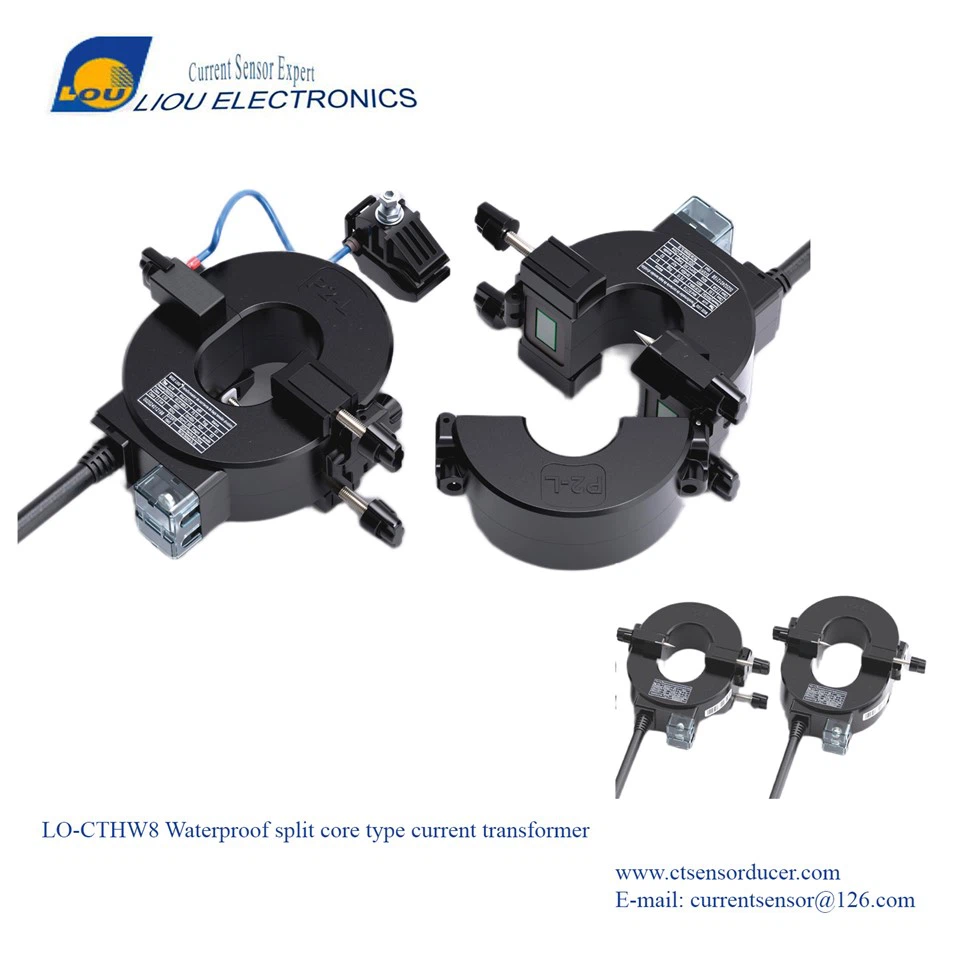
One of our flagship products is the Waterproof Split Core CT For Public Infrastructure Monitoring LO - CTHW8. This transducer is specifically designed for public infrastructure monitoring, where reliable and accurate current measurement is essential.
8. Contact for Procurement
If you are looking for split core current transducers for your application, whether it's for high - frequency or low - frequency current measurement, we are here to help. Our team of experts can provide you with detailed information about our products and help you select the right transducer for your needs. We are committed to providing high - quality products and excellent customer service. Please feel free to contact us for procurement and further discussions.
References
- Grover, F. W. (1946). Inductance Calculations: Working Formulas and Tables. Dover Publications.
- Halliday, D., Resnick, R., & Walker, J. (2014). Fundamentals of Physics. Wiley.
- Popovic, R. S. (2006). Introduction to Sensors. Springer.