




What is the input current range of Closed Loop Hall Effect Sensors?
 Jan 06, 2026|
 Alright, folks! As a supplier of Closed Loop Hall Effect Sensors, I often get asked about the input current range of these nifty devices. So, I thought I'd sit down and write this blog to clear things up.
First off, let's quickly understand what Closed Loop Hall Effect Sensors are. They're a type of sensor that uses the Hall effect to measure current. The Hall effect is a phenomenon where a voltage difference is created across an electrical conductor when it's placed in a magnetic field perpendicular to the current flow. In a closed - loop sensor, there's a feedback mechanism that helps in achieving high accuracy and linearity.
Now, coming to the main question: What's the input current range of Closed Loop Hall Effect Sensors?
The input current range can vary widely depending on the specific application and the design of the sensor. For general industrial applications, we commonly see input current ranges starting from a few amperes and going up to several hundred amperes. For instance, in some motor control systems, sensors might be required to measure currents in the range of 5 - 50 amperes. These are relatively low - current applications where precision is key, and Closed Loop Hall Effect Sensors can offer excellent performance.
On the other hand, in high - power applications such as those in power distribution systems or large - scale industrial machinery, the input current range can be much higher. We're talking about sensors that can handle currents from 100 amperes all the way up to 1000 amperes or even more. These high - current sensors are designed with robust components and advanced magnetic core materials to ensure accurate measurement under such extreme conditions.
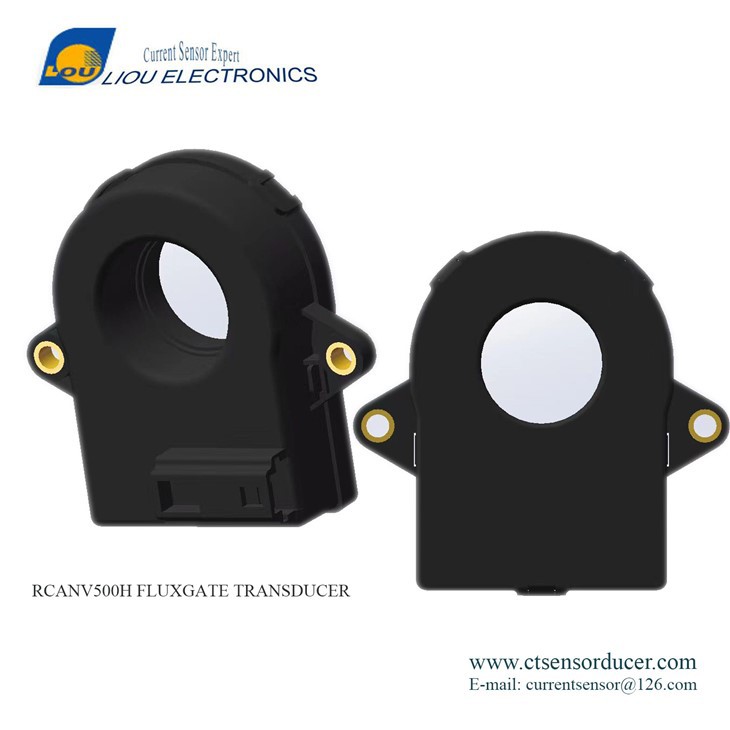
Let's take a look at some of our products to get a better idea. Take the AUTOMOTIVE CURRENT TRANSDUCER BMS BDU PDU RCANV500H. This sensor is specifically designed for automotive applications, such as in Battery Management Systems (BMS), Battery Disconnect Units (BDU), and Power Distribution Units (PDU). It has an input current range that's well - suited for the requirements of modern electric vehicles. The range is carefully calibrated to provide accurate current measurements for the charging and discharging processes of the vehicle's battery.

Another great product is the High‑Precision Hall‑Effect Current Sensor For Electric Vehicle Charging Stations LO - CL2A - 300. As the name suggests, this sensor is intended for use in electric vehicle charging stations. Here, the input current range is optimized to handle the currents that flow during the charging process. Since charging stations can have different power ratings, the sensor needs to be able to accurately measure a range of currents. This sensor provides high precision within its specified input current range, ensuring the charging process is safe and efficient.
Then there's our Closed Loop Hall Effect High Current Sensor. As the name implies, this sensor is engineered to handle high currents. It's suitable for industrial applications where large amounts of current need to be monitored. The input current range of this sensor is designed to meet the demands of heavy - duty equipment, providing reliable and accurate current measurements even under high - stress situations.
When it comes to choosing the right input current range for a particular application, there are a few factors to consider. First, you need to know the maximum and minimum currents that will be present in the system. For example, if you're working on a small electronic device, you probably won't need a sensor with a very high input current range. On the other hand, if you're dealing with large industrial machinery, a sensor with a high - end input current range is a must.
Accuracy requirements also play a huge role. In applications where precise current measurements are crucial, such as in medical devices or aerospace systems, the input current range should be carefully selected to ensure that the sensor operates within its most accurate range. Additionally, the environment in which the sensor will be used matters. High - temperature or high - humidity environments can affect the performance of the sensor, and you may need to choose a sensor with a wider input current range to account for any potential variations.
We're constantly working on improving our Closed Loop Hall Effect Sensors. Through research and development, we're able to expand the input current ranges of our sensors while maintaining or even enhancing their accuracy and reliability. We also pay close attention to customer feedback, which helps us tailor our products to better meet the specific needs of different industries.
If you're in the market for a Closed Loop Hall Effect Sensor, or if you have any questions about input current ranges or our products in general, don't hesitate to reach out. We're here to help you find the perfect sensor for your application. Whether you're a small - scale manufacturer or a large industrial giant, we've got the right solutions for you.
In conclusion, the input current range of Closed Loop Hall Effect Sensors can vary significantly based on the application. From small - current automotive applications to high - power industrial setups, there's a wide spectrum of input current ranges available. And at [Supplier], we're dedicated to providing you with the best - in - class sensors that meet your specific requirements. So, give us a shout if you want to start a procurement discussion and find out how our sensors can benefit your business.
References
- Scientific articles on Hall effect sensors and their applications in current measurement.
- Technical documentation of our company's Closed Loop Hall Effect Sensors.