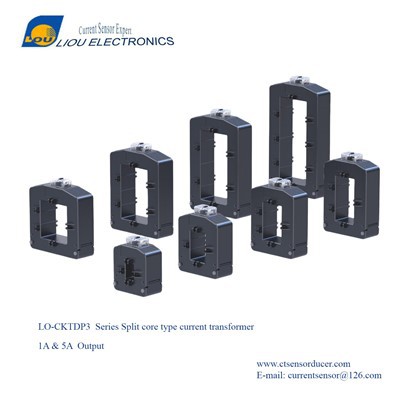
How to Determine if the Wiring of an Open-Type Current Transformer is Correct
 Aug 10, 2026|
I. Initial Inspection of Appearance and Continuity
1. Check that the secondary circuit has no easily disconnectable components such as fuses or switches, and that all terminals are securely fastened.
2. Use a multimeter in continuity mode to test the secondary circuit, confirming that it is continuously conductive with no open circuit points, and that the S2 terminal is reliably grounded.
3. Verify that the conductor cross-sectional area is ≥2.5mm² copper core wire, and that there are no signs of damage, loose connections, or wear.
II. Polarity Verification
1. Dry Cell DC Method: Connect P1 to the positive terminal of a dry cell battery and P2 to the negative terminal on the primary side. Connect S1 to the positive terminal of a pointer multimeter in milliampere mode and S2 to the negative terminal on the secondary side. If the pointer deflects positively the moment the battery is connected, it indicates that P1 and S1 are terminals of the same polarity, and the polarity is correct.
2. Phase Comparison Method: With a load, use a phase meter to measure the phase of the primary and secondary currents. If the phase difference is close to 0°, the polarity is correct; if the phase difference is 180°, the polarity is reversed.
III. Load Operation Verification
1. Measure the secondary output current with a clamp meter. If the deviation from the theoretical value (converted from the actual primary current according to the transformer ratio) is ≤5%, it indicates no wiring abnormalities.
2. In a three-phase system, the secondary current values of each phase are nearly equal, with no phase current being zero or showing excessive deviation.
3. The meter does not reverse, and the protection device does not malfunction or fail to operate, indicating the wiring logic is completely correct.
IV. Troubleshooting Typical Errors
1. If the energy meter reverses, it is highly likely that the secondary side S1/S2 is reversed, indicating incorrect polarity.
2. If the secondary current is zero, it indicates an open circuit in the secondary circuit, requiring immediate power disconnection and investigation.
3. If the measured value deviation is excessive, check for issues such as the transformer opening not being fully closed or the conductor not being centered during installation.